
SSE real-time push
TodoAI's "real-time" has three layers: server → SSE → browser → cross-component events. Each has its own boundary and constraints.
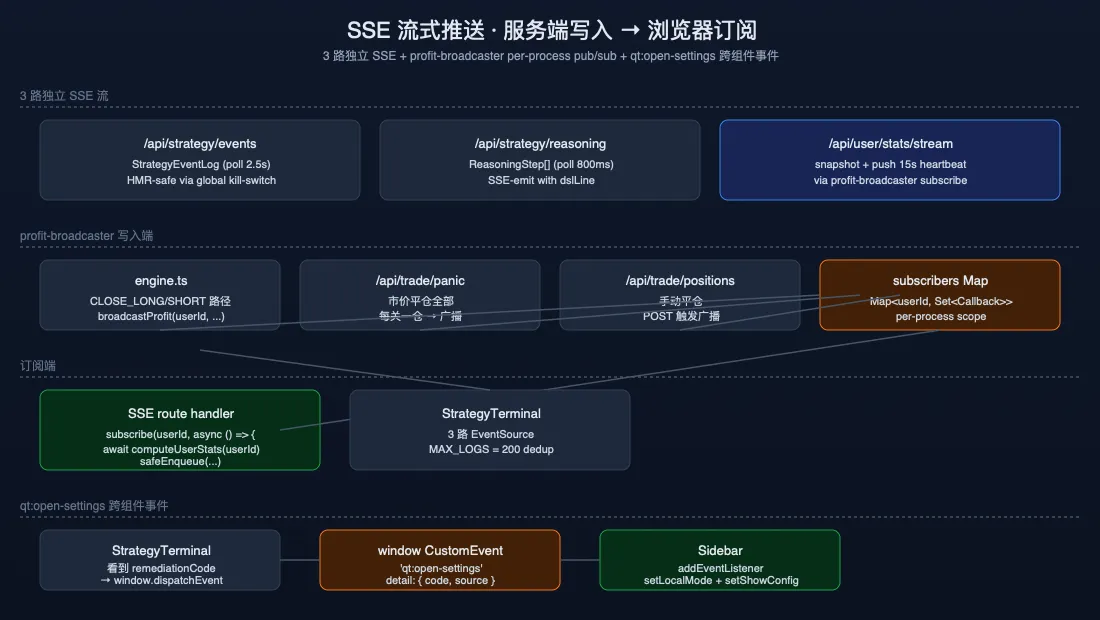
Three independent SSE streams
StrategyTerminal subscribes to three streams in parallel, each with its own purpose:
| Endpoint | Purpose | Poll cadence |
|---|---|---|
/api/strategy/events | Strategy BUY/SELL/HOLD/ERROR events | 2.5s |
/api/strategy/reasoning | Reasoning steps (while generating) | 800ms |
/api/user/stats/stream | winStreak / winRate snapshot + pushes | 15s heartbeat |
Each one:
- Authenticates with
getServerSession(PR1–PR3 IDOR) - Registered with HMR kill-switch (
globalThissymbol); old controllers force-closed on HMR reload - Checks
closedflag beforeenqueue+ try/catchTypeErrorto defend against controller race - Sets
Cache-Control: no-cache, no-transform,X-Accel-Buffering: no(prevents nginx buffering)
The terminal accumulates logs in useState, dedup by id + capped at TERMINAL_MAX_LOGS = 200.
In-process pub/sub: profit-broadcaster
When a close path (engine / panic / manual close) completes, we want every subscribed SSE client to push new data immediately. We cannot have each writer push directly to SSE controllers — they belong to different requests, and shouldn't know about subscribers.
src/lib/profit-broadcaster.ts is a single-process pub/sub mediator:
// Writer (any close path)
broadcast(userId, {
  type: 'profit_record_created',
  pnl, pnlPercent,
});

// Reader (/api/user/stats/stream route)
unsubscribe = subscribe(userId, async () => {
  await computeUserStats(userId);
  safeEnqueue(encoder.encode(...));
});
The writer carries no business logic — it only signals "something happened". The reader recomputes from the DB on each signal and pushes.
Current scope is single-process (Map<userId, Set>). Multi-instance deployments need to swap to Redis pub/sub (Redis is already in the stack via Upstash for tier cache).
Cross-component UI events: qt:open-settings
StrategyTerminal and Sidebar live in different parts of the tree. React context communication requires lifting state up or Zustand/Redux. For one-off coordination, a plain window event is the simplest:
// StrategyTerminal
if (data.remediationCode) {
  window.dispatchEvent(new CustomEvent('qt:open-settings', {
    detail: { code: data.remediationCode, source: 'strategy_terminal' },
  }));
}

// Sidebar
useEffect(() => {
  const onOpenSettings = () => {
    setLocalMode(tradingMode);
    setShowConfig(true);
  };
  window.addEventListener('qt:open-settings', onOpenSettings);
  return () => window.removeEventListener('qt:open-settings', onOpenSettings);
}, [tradingMode]);Conventions:
- Event names use the
qt:*namespace - Payload stays small, only essential IDs
Sidebaris the canonical listener forqt:open-settings— new triggers should reuse the same channel rather than introducing a second
HMR safety
In Next.js dev mode, module reloading re-evaluates route handlers, but the old instance's setInterval callbacks keep running. If not handled:
- Old callbacks send data to a controller already replaced by the new module →
ERR_INVALID_STATE: Controller is already closed - Multiple old polls run simultaneously → data doubled
Solution: store intervals / controllers on globalThis[symbol]; on every module evaluation, clear the old instances first.
See /api/strategy/events's HMR_INTERVALS_KEY implementation.
Why SSE instead of WebSocket?
We considered WebSocket. We chose SSE in the end:
- Browser-native
EventSourcewith auto-reconnect - HTTP/1.1 long connection, easy through reverse proxies
- Server-to-client push only is enough (we don't need bi-directional)
- Heartbeat (just a
: heartbeatcomment line) can be piggybacked within 15s
If we need bi-directional in the future (e.g. cancelling a running backtest from the client), we'll switch to WS.