
ccxt error normalization
ccxt throws messy error blobs: Invalid Api-Key, Passphrase wrong, fetch failed, ECONNRESET... each one needs a different fix, but the frontend just sees "Error".
src/lib/exchange-errors.ts is the mandatory translation step before any exchange call crosses the API boundary.
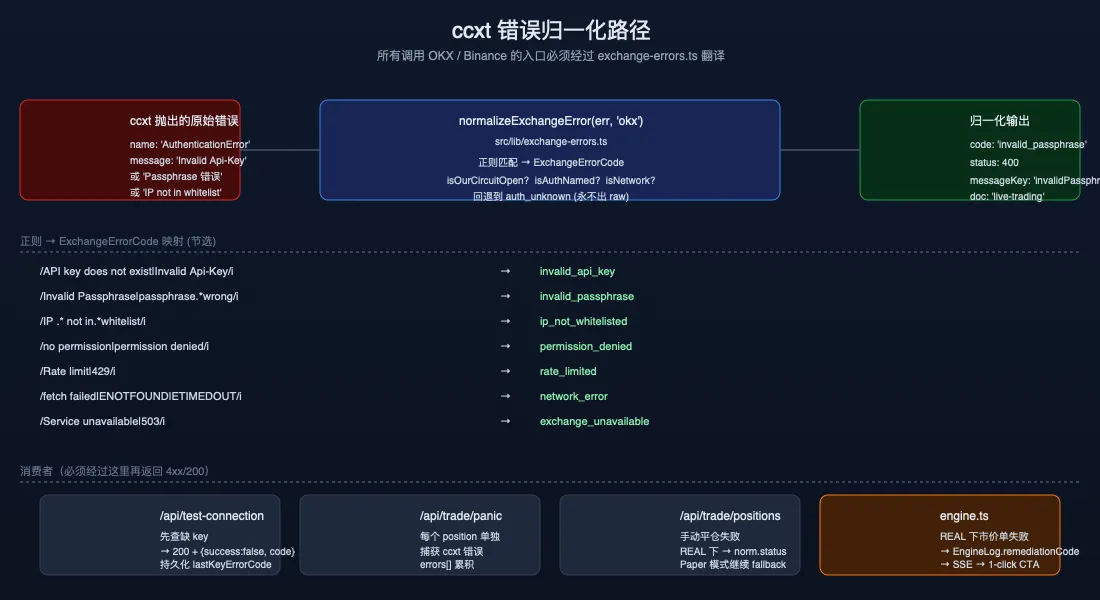
Translation
import { normalizeExchangeError } from '@/lib/exchange-errors';

const norm = normalizeExchangeError(err, 'okx');
// → {
//   code: 'invalid_passphrase',
//   status: 400,
//   messageKey: 'invalidPassphrase',
//   doc: 'live-trading',
//   hint: 'The Passphrase is the field you typed when creating the API on OKX — not your OKX login password.',
// }
Returns 4 key fields:
| Field | Purpose |
|---|---|
code | Public ExchangeErrorCode string (API-safe) |
status | HTTP status the API boundary should return (4xx = user can fix) |
messageKey | i18n key, frontend looks up zh/en table |
doc | in-app docs slug (live-trading, api-keys, etc.) |
Error code table
| ExchangeErrorCode | Trigger | User action |
|---|---|---|
invalid_api_key | OKX returns "API key does not exist" | Re-copy the Key |
invalid_passphrase | OKX returns "Invalid Passphrase" | Use the one you set at creation, not the login password |
ip_not_whitelisted | OKX returns "IP not in whitelist" | Disable whitelist or add IP |
permission_denied | OKX returns "no permission" | Enable Read + Trade, do not enable Withdraw |
invalid_signature | OKX returns "Invalid Sign" | Copy the full Secret, don't trim |
invalid_timestamp / expired_timestamp | Clock skew | Retry |
rate_limited | 429 | Wait a few seconds |
insufficient_balance | Not enough to place order | Top up |
min_amount | Below minimum | Increase tradeAmount |
symbol_not_found | Wrong symbol | Switch symbol |
network_error | fetch failed / ENOTFOUND | Check network |
exchange_unavailable | 503 | Wait |
circuit_open | Breaker open (3 fails / 60s) | Wait 60s |
auth_unknown | Fallback | Open Settings |
Entries that must go through normalize
Every exchange call that crosses the API boundary must use normalizeExchangeError:
| Route | Behavior |
|---|---|
/api/test-connection | On failure, return 200 + {success:false, code, messageKey, doc, hint} (the test itself succeeded, the result is "fail") |
/api/trade/panic | In REAL, market order failure → accumulate in errors[] |
/api/trade/positions | In REAL, manual close failure → 4xx + structured error |
engine.ts three order sites | Return EngineLog.remediationCode |
engine.ts candle fetch failure | Attach norm.code on EngineError.remediationCode and rethrow |
Never return error.message to the API boundary — that's ccxt's internal string, may leak internals, and users can't read it.
Consistency rule
The JSON shape returned at the API boundary is fixed:
{
  success: false,
  code: 'invalid_passphrase',     // ExchangeErrorCode
  messageKey: 'invalidPassphrase', // i18n key
  doc: 'live-trading',              // in-app doc slug
  hint: '...',                      // optional
  // Legacy field kept for backward compat:
  error: 'Raw message for debugging',  // not rendered to user, only logged
}
The frontend (StrategyTerminal, Sidebar, Onboarding modal) consistently uses code + messageKey + doc for rendering. The error field is logged only.
Why not use ccxt's built-in error types?
ccxt's AuthenticationError / ExchangeNotAvailable are coarse "categories" that don't distinguish:
- Wrong API Key vs wrong Passphrase vs IP not whitelisted — all
AuthenticationError - Timeout vs DNS failure vs 503 — all
NetworkError
Our ExchangeErrorCode is a finer-grained, user-actionable classification aligned with our onboarding flow. The 1-click fix UX depends entirely on this precision.
Adding a new exchange
Add a BINANCE_PATTERNS (already there) next to OKX_PATTERNS. When adding a new OKX error code, extend the OKX_PATTERNS list first — don't invent a new ExchangeErrorCode unless none of the existing ones fit.